The governor’s mother-of-pearl shoes
Grey BeesThe governor’s mother-of-pearl shoes turn a brief visit to Sergey Sergeyich’s apiary into a vivid encounter with luxury, then return as an unexpectedly intimate gift. Their dazzling surface first makes Sergeyich look and look again; when he discovers the same shoes in a box left by the governor’s assistant, their oversized fit and concealed dollars reveal that they are not practical footwear but a keepsake. The shoes bring together the governor’s public authority, the beekeeper’s bee-bed, and the private value of an object kept rather than spent.
Appearance and First Encounter
When the governor visits the orchard, Sergeyich leads him to six hives arranged back to back in pairs. A wooden sheet and a thin mattress cover them, making the hives a place to lie down as well as a working apiary. Asked whether he should remove his shoes, the governor receives a shake of the head from his host—but Sergeyich’s attention has already been caught by the footwear.
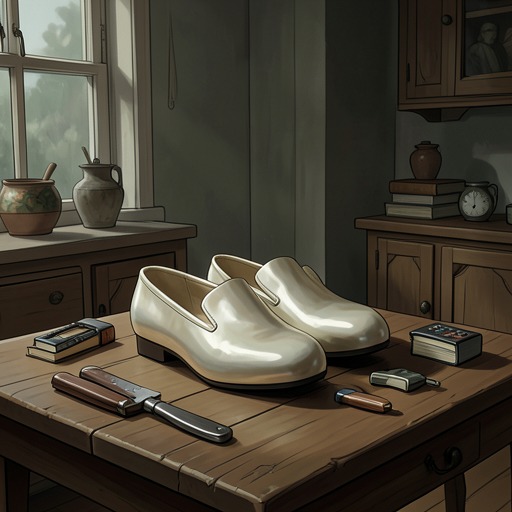
The shoes are sharp-nosed and exquisite in shape, their mother-of-pearl colour throwing shifting, iridescent light. The narration compares that sheen to petrol on sunlit water, while insisting that the shoes possess a nobility petrol lacks. Their brilliance seems to make the air above them waver and lose transparency, enlarging the impression of colour and form. This description gives the shoes an almost unreal visual force: in the orchard, they are not merely worn but command the scene.
The governor notices Sergeyich staring and asks whether he likes them. Sergeyich admits that he has never seen anything so beautiful. When asked his size, he answers forty-two. The exchange makes the shoes’ impact personal: the governor has elicited a precise detail from his host, but the admiration is not a claim that the pair would fit him. The shoes remain an object of looking before they become an object Sergeyich can hold.
The Bee-Bed and the Governor
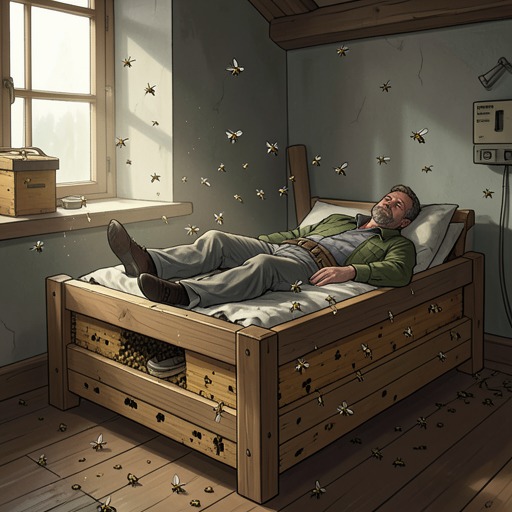
The visit also places the shoes beside Sergeyich’s distinctive bee-bed. A wooden step stool stands at the base of a hive; the governor climbs onto it, lowers himself carefully onto the thin mattress, lies on his right side, and stretches out his legs. He then looks at Sergeyich with the childish uncertainty of a schoolboy before a strict teacher and asks which position is best. Sergeyich recommends lying on the back, where the body has maximum connection with the hives.
In a later dream, the governor reappears in the orchard as Sergeyich lies among his bees. Green branches, sunlight, and ripe Antonovka apples surround them; the governor sits nearby on a folding fishing chair, reading and chuckling, while two bodyguards watch silently from beneath the trees. When Sergeyich realizes that his guest also wants to lie on the bee-bed, he rises to straighten the mattress and goes to fetch a fresh sheet. The shoes recur as the dream’s sharpest visual detail: the governor removes them and places them neatly on the grass, their mother-of-pearl toes pointing toward the step stool, before climbing onto the middle hive and lying on his back.
The dream prolongs the earlier visit by reversing the positions of host and guest. Sergeyich, who had watched the governor’s shoes with open wonder, now sees them set aside as the governor enters the beekeeper’s world and accepts its simple arrangement of hives, stool, and mattress. The governor grins when he catches Sergeyich looking at the shoes again. The pair connects official importance to the ordinary intimacy of the bee-bed without dissolving the difference between them: even in this shared resting place, Sergeyich’s attention returns to the conspicuously beautiful object.
Gift and Hidden Money
The shoes acquire a second life after a later visit from the governor’s assistant. The assistant says something happens every day where the governor is and explains that his boss has asked him to pass along a gift. Sergeyich looks inside the bag and sees a box of the kind used for shoes. The assistant then asks to lie on the hives himself, and Sergeyich agrees. After about three minutes among the bees, the visitor gets down, brushes off his suit, and leaves.
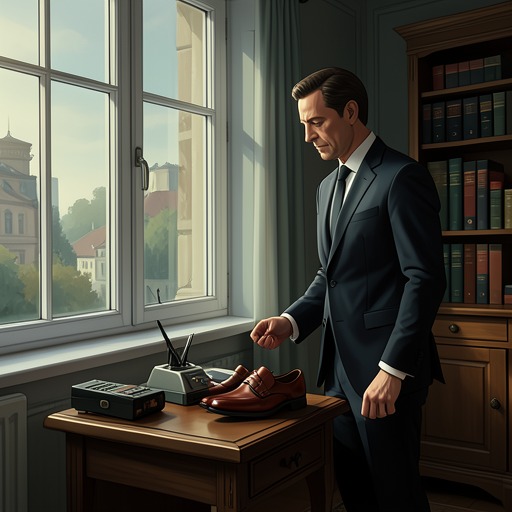
Once the jeep has driven away, Sergeyich carries the shoebox inside. It contains a pair of the astonishing mother-of-pearl shoes. He spreads a newspaper on the floor, puts them down, and tries them on. Their effect is no longer visual wonder alone: they are about five sizes too large, and wearing them makes him feel as if he is swimming. That mismatch supplies the decisive clue. These are not a new pair chosen to fit him, but the very shoes his guest wore—the same pair Sergeyich had admired in the orchard.
A crunch of paper leads to another discovery. Sergeyich reaches into the toes and pulls out four hundred dollars, two hundred from each shoe. The cash transforms the shoes from an impressive castoff into a keepsake with concealed value. The money is substantial enough to become part of his savings, but it does not turn the footwear into something he uses: the shoes remain too large, and the dollars remain hidden inside them until he checks.
What Sergeyich Keeps
Sergeyich never spends the four hundred dollars. He stores it in the sideboard, inside one of his books, alongside his other savings. Remembering where he put the money, he glances at the dozen books behind the sideboard’s glass door and worries that Pashka might come asking for something to read. Sergeyich knows Pashka well enough to fear that, if he found money inside a book, he would never admit to it. The shoes’ contents thus enter the ordinary economy of Sergeyich’s home, where savings must be hidden and remembered rather than displayed.
The object’s meaning rests on the contrast between its first appearance and its eventual use—or, more precisely, its non-use. At the governor’s feet, the shoes gleam as an extraordinary sign of beauty and privilege. In Sergeyich’s house, they are far too large to wear, yet their identity as the very pair from the orchard gives them the character of a personal memento, while the concealed dollars become a reserve he preserves. The shoes make the governor’s brief passage through the apiary tangible after he has gone, carrying both the image Sergeyich could not stop admiring and a practical, carefully guarded gift.